Slides
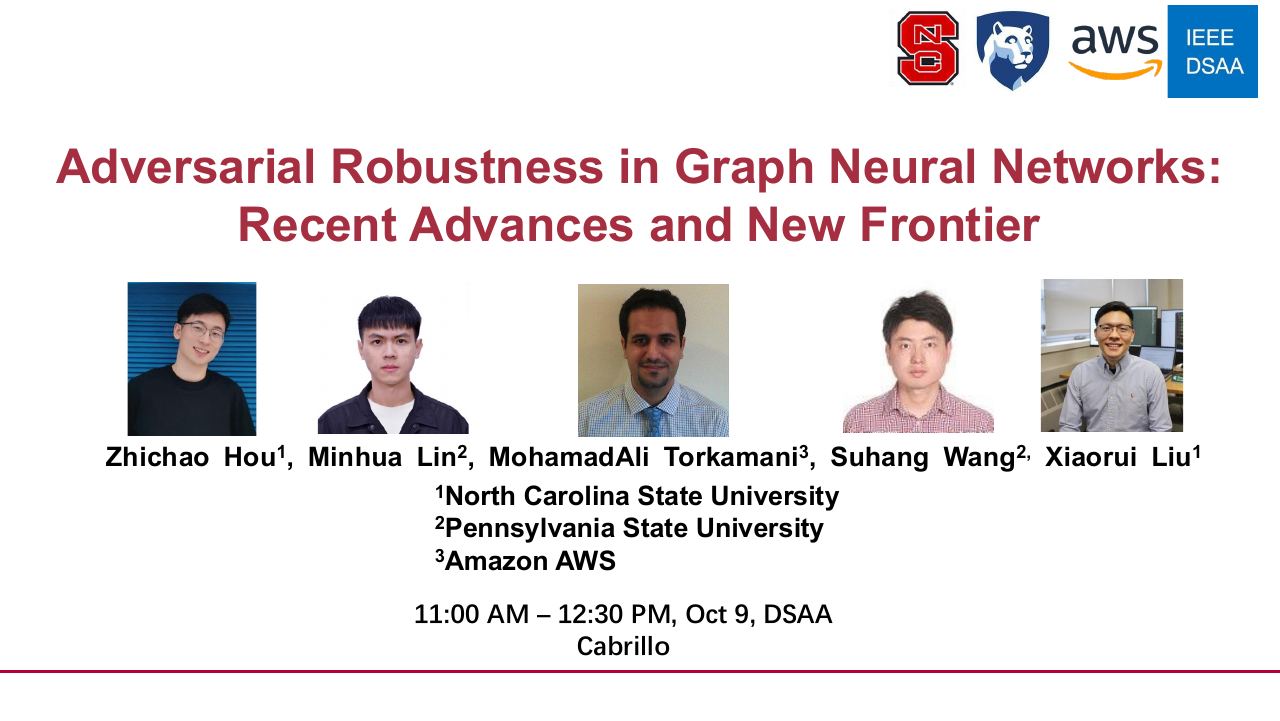
Recent Advances and New Frontier
1North Carolina State University 2Pennsylvania State University 3Amazon AWS
October 9, 2024 · 11:00–12:30 AM · Room Cabrillo
In recent years, Graph Neural Networks (GNNs) have attracted substantial attention due to their powerful ability in modeling graph-structured data and broad applications across domains such as social media, biology, health, and finance. Despite these successes, GNNs exhibit significant vulnerabilities to adversarial attacks, which poses challenges to their reliable deployment in real scenarios. This tutorial gives an in-depth exploration of existing adversarial attacks and state-of-the-art techniques for enhancing GNN robustness — attack and defense methods, evaluation and comparison of robust GNN models, and a discussion of open future directions.
Index Terms—Graph Neural Networks; Adversarial Attacks; Robustness
This tutorial covers past and recent efforts in the adversarial robustness of GNNs. It is intended for researchers interested in both attacking and safeguarding GNNs, whether the goal is finding new failure modes or building systems that resist them. Attendees are expected to have a basic understanding of machine learning, optimization, and statistics; no prior graph learning background is assumed.
II, continued — what each session covers
A brief introduction to Graph Neural Networks, including popular architectures and their broad applications [8] [12] [16]. We then illustrate the vulnerability of GNNs and the resulting impact in real scenarios, especially privacy- and security-sensitive settings [2], and motivate why safeguarding GNNs against increasingly sophisticated attacks matters — both theoretically and empirically [14].
A comprehensive overview of adversarial attacks on graphs, categorized by attack knowledge [3] [20] [26], attack phase, attack mechanism [25], and attack target — plus scalable attacks on large graphs. For each category we describe the key methods and their distinctions, and walk through commonly used attacks, their mechanisms, and their limitations.
Current advances in robust GNN defenses from multiple perspectives: classic strategies including robust training [1] [6] [20], graph cleaning [5] [11] [19], and attention mechanisms [9] [22] [24]; certifiable defenses and optimization-induced architectures [7] [13] [21]; and defenses tailored to specific scenarios — directed graphs [10], large-scale graphs [4], and specialized theoretical frameworks [15] [23].
A thorough assessment of the preceding methods against various adversarial attacks, revealing the resilience of robust GNNs under different settings and offering guidance on selecting a defense for a given scenario. We also discuss implications for real-world applications, including social networks and fraud detection [18].
We close with a summary of the tutorial and motivating discussion on open future directions for GNN robustness.

Research interests include machine learning on graphs and adversarial machine learning.

Research interests lie in data mining, graph neural networks, and trustworthy machine learning.

Ph.D. in Computer Science, University of Oregon (2016). 17+ years across graphical models, adversarial ML taxonomy, structured prediction, and deep learning.

Ph.D. in Computer Science, Arizona State University (2018). Research in graph mining, trustworthy machine learning, and deep generative models — 130+ publications, 18,200+ citations, h-index 57.

Ph.D. in Computer Science, Michigan State University (2022). Research in deep learning on graphs, large-scale machine learning, and trustworthy artificial intelligence.